
What Are Soft Crafts? Where MABI Tools Fit in Industrial Specialty Services
In industrial maintenance, the term soft crafts is often used to describe the specialist support trades involved in plant maintenance, turnarounds and refurbishment projects.
These services may also sit within the broader category of specialty services, depending on how a contractor or facility groups its maintenance, access, insulation, coatings, abatement and surface preparation work.
Although the exact definition varies between contractors and industries, soft crafts commonly include scaffolding, insulation, metal jacketing, painting, coatings, abatement, fireproofing, surface preparation and general maintenance support.
These are skilled craft trades that help maintain, protect and reinstate industrial assets. Organizations such as NCCER provide training and credentials across construction and industrial craft disciplines, including industrial maintenance, which supports the wider recognition of these trades as specialist craft skills.
Despite the name, soft craft work is often physically demanding. Teams may be working at height, inside tanks, around piping, in confined spaces, or on awkward plant structures where access is limited and control is essential.
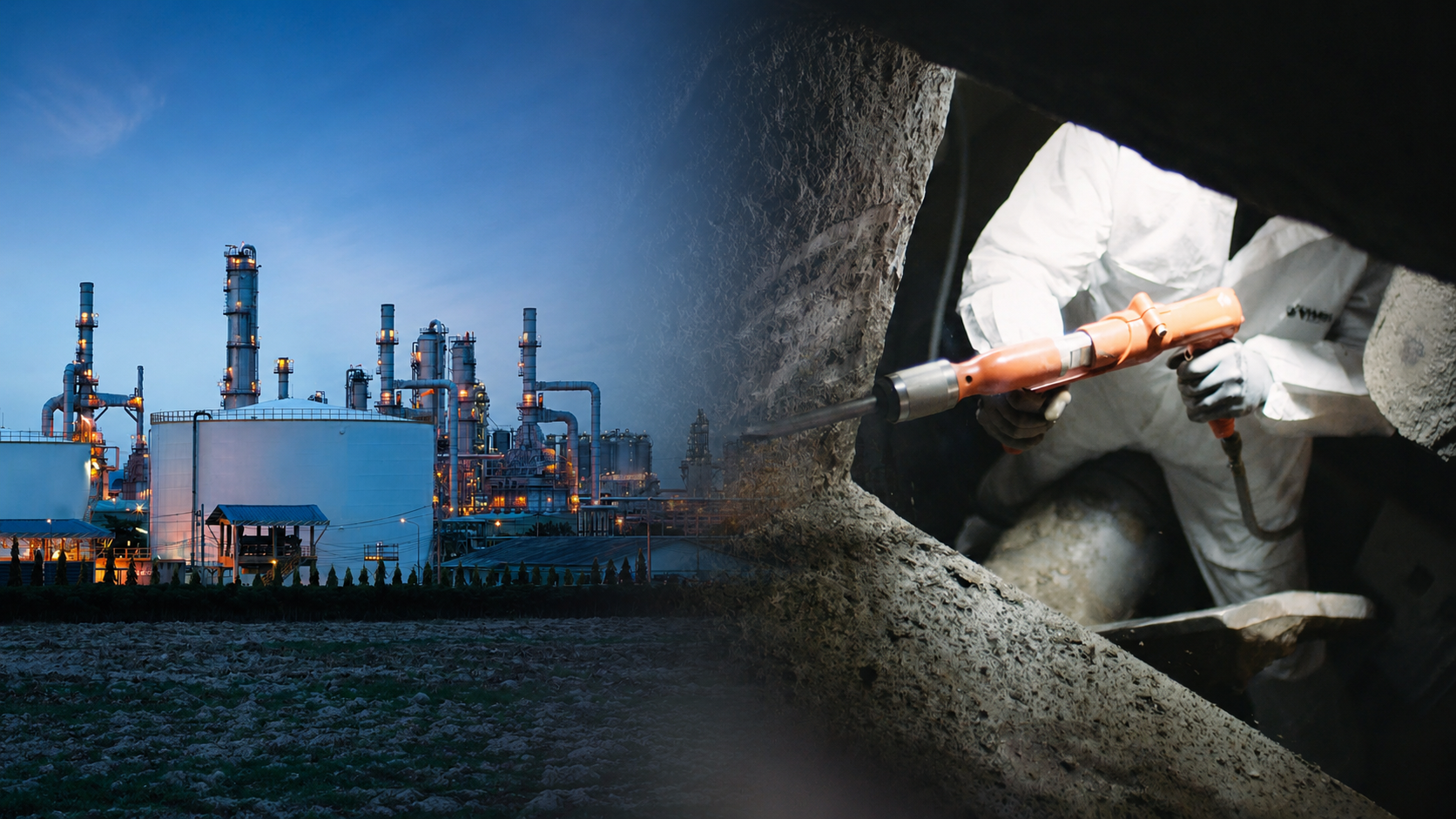
For many of these soft craft and industrial specialty services applications, MABI lightweight ergonomic pneumatic tools offer a practical solution for scraping, chipping and controlled material removal.
What Are Soft Crafts and Industrial Specialty Services?
Soft crafts are the trade services that support the maintenance, repair and protection of industrial assets.
This can include removing and replacing insulation, stripping old metal jacketing, preparing steel before coating, removing damaged fireproofing, cleaning residue from tanks or vessels, and supporting abatement or refurbishment work.
The term specialty services is often broader. It can include soft crafts, but may also cover related contractor scopes such as industrial cleaning, refractory work, rope access, confined space work, tank and vessel maintenance, and other specialist maintenance support.
In simple terms, soft crafts are often one part of a wider specialty services offering.
Soft craft and specialty service teams are often involved before, during and after larger maintenance activities. Their work helps prepare assets for inspection, repair, recoating or reinstatement.
Why Tool Choice Matters in Soft Craft Work
Soft craft work often takes place in areas where larger machines cannot be used.
Operators may be working from scaffold, inside restricted spaces, around pipe supports, or in areas with limited access. In these conditions, tool weight, vibration, control and reliability become just as important as impact power.
Traditional heavy breakers may provide force, but they can be tiring and difficult to control over long periods. Hand tools may offer precision, but they are often too slow for production work.
This creates a need for compact, powerful tools that can remove material efficiently without adding unnecessary strain to the operator.
Pneumatic Tools in Industrial Plants and Hazardous Classified Locations
Many industrial plants have areas where flammable vapors, gases, combustible dusts or fibers may be present. OSHA’s hazardous classified locations standard covers electric equipment and wiring in these environments, depending on the materials present and the likelihood of a flammable or combustible concentration being present.
OSHA also highlights combustible dust as an explosion hazard, noting that combustible material in finely divided form can become explosible when suspended in air under the right conditions.
This is one reason pneumatic tools can be a practical option in certain industrial plants, refineries, chemical facilities, grain handling sites, foundries and other maintenance environments where electric tools may be restricted.
MABI tools are air-powered, lightweight and easy to control, making them well suited to scraping, chipping and controlled material removal in difficult access areas.
For sensitive industrial applications, MABI can also offer non-sparking chisels, helping contractors match the tool setup to the jobsite requirements.
Final tool selection should always follow the site risk assessment, hazardous area classification and the facility’s safety procedures.

Where MABI Tools Are a Good Fit
MABI tools are well suited to many soft craft and specialty service applications because they combine pneumatic impact power with a lightweight, ergonomic design.
Typical applications include:
Insulation and metal jacketing removal
Removing old insulation, mastics, sealants, adhesives and residue from tanks, piping and vessels.
Coatings and surface preparation
Localized coating removal, edge work, detail cleaning and preparation around steelwork, fixings and welds.
Fireproofing and refractory removal
Controlled chipping of damaged or deteriorated material where access and operator control are important.
Abatement and controlled removal work
Scraping and stripping materials in areas where compact pneumatic tools are preferred over heavy electric breakers.
Tanks, silos and confined spaces
Working inside difficult access areas where tool size, weight, durability and setup time can affect productivity.
Industrial cleaning and specialty maintenance
Removing built-up material, residue or coatings from difficult access areas where larger equipment cannot reach.
Hazardous industrial environments
Using pneumatic tools and non-sparking chisels where electric tools may be restricted and ignition risk must be carefully managed.

Lightweight Pneumatic Power Without the Usual Compromise
One of the main challenges in soft craft and industrial specialty service work is balancing power with usability.
Operators need enough impact to remove stubborn material, but they also need a tool they can handle safely and productively throughout the shift.
MABI tools provide a useful middle ground: more productive than manual scraping, lighter and easier to control than many heavy breakers, and suitable for awkward work where larger equipment cannot reach.
Because they are pneumatic, they also avoid some of the common issues associated with electric and battery tools, such as overheating motors, flat batteries, charging downtime and long cord runs.
A Versatile Tool for Multi-Trade Industrial Contractors
Soft craft and specialty service contractors often support a wide range of tasks across the same site. A single crew may be involved in insulation, coating preparation, abatement, cleaning, access work and repair preparation.
MABI tools are a strong fit for this environment because they are versatile, easy to set up and suited to many different removal tasks.
For industrial maintenance contractors, branch managers and project teams, they offer a practical tool for the areas where hand tools are too slow and larger machines are too heavy, too bulky or simply cannot reach.
Conclusion
Soft craft work may cover a wide range of trades, while specialty services can describe an even broader range of industrial contractor scopes. In both cases, many of the challenges are the same: difficult access, awkward working positions, stubborn material, operator fatigue and the need for controlled removal.
MABI lightweight ergonomic pneumatic tools are designed for exactly this type of work.
They help soft craft and industrial specialty service teams remove material efficiently, improve control and reduce the compromise between power, weight and access. In industrial environments where electric tools may be restricted, the pneumatic design and availability of non-sparking chisels can also provide an important practical advantage.